Friday, October 27, 2017

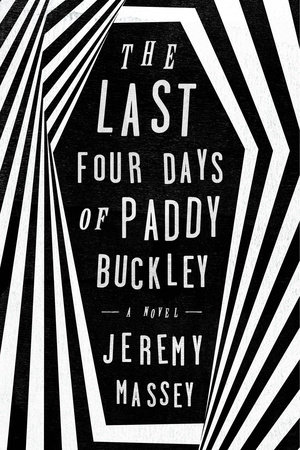
The Last Four Days of Paddy Buckley by Jeremy Massey Review

WARNING: THERE MAY BE SPOILERS BELOW

“This misery of a gig called life is just a dream from which we all eventually awaken, he said. Nobody gets left behind. Even the most horrible dreams end.”- The Last Four Days of Paddy Buckley, Jeremy Massey
Paddy Buckley is a grieving widower who has worked for years for Gallagher’s, a long-established—some say the best—funeral home in Dublin. One night driving home after an unexpected encounter with a client, Paddy hits a pedestrian crossing the street. He pulls over and gets out of his car, intending to do the right thing. As he bends over to help the man, he recognizes him. It’s Donal Cullen, brother of one of the most notorious mobsters in Dublin. And he’s dead.

Shocked and scared, Paddy jumps back in his car and drives away before anyone notices what’s happened.

The next morning, the Cullen family calls Gallagher’s to oversee the funeral arrangements. Paddy, to his dismay, is given the task of meeting with the grieving Vincent Cullen, Dublin’s crime boss, and Cullen’s entourage. When events go awry, Paddy is plunged into an unexpected eddy of intrigue, deceit, and treachery.

By turns a thriller, a love story, and a black comedy of ill manners, The Last Four Days of Paddy Buckley is a surprising, compulsively readable debut novel.


Every so often, one comes across a book that he swears was made for him. The Last Four Days of Paddy Buckley is that for me. A funeral director main character. Organized crime. Black comedy. An international setting that also happens to be the same place my favorite series of this year is set in. Prose evocative of my favorite contemporary writer of all time, Markus Zusak. Even some particularly messed up moments. The writer is even an Irishman living in Australia! How the hell did it take me so long to find this book?

Also, Jeremy Massey was called, in one review, the Irish Carl Hiaasen. Growing up, Hiaasen's YA/children's novels were some of my favorite books out there- especially Flush (I should really dig that book out again). If I had any reservations about reading it before I definitely didn't after reading that comparison.

Not since Marina have I read a book so easy for me to fall in love with. It just has everything that works for me, a great plot line, awesome characters, a fantastic writing style. So why didn't it get the same high grade Marina got? Well, mostly because the book does have some flaws that were a bit too obvious for me to fully love this book. Like, I wasn't crazy about the sometimes random POV changes. They were a necessity, I get it, but I still found it jarring to go from a quite pleasant first person narrative to suddenly jump to Jack or Geno or Vincent or whoever with little warning. That could have been done better. I also wasn't too keen on the love story between Paddy and Brigid (though I admit the ending makes up for it). Those things annoyed me just enough to knock it down from a full 9 out of 10 to an 8.5-9. 

I brought up Markus Zusak because Paddy Buckley reminded me strongly of Ed Kennedy in I Am the Messenger, which as you know holds the title of my favorite contemporary of all time. I don't even know how to describe it except by saying that they both have a very... pleasant narrative style and strike me as the kind of people you'd get on with well in real life. They seem realistic, too, dealing with the often strange situations they find themselves in the same way people would in real life and, while they aren't impervious to fear, they have a calmness about them you could respect. If you can't tell by that, I really liked Paddy Buckley and could read three more books following him around (though I think this works quite well as a standalone and wouldn't necessarily want a sequel). 

As is often the case when I really enjoy a book, I have little to say about it. The book just worked for me. It's not by any means fine literature, but it's a ton of fun to read and one that will definitely make an appearance on my end of the year best of list. 


8.5-9 out of 10

Wednesday, October 25, 2017

Music of the Ghosts by Vaddey Ratner Review

WARNING: THERE MAY BE SPOILERS BELOW

In the absence of sight, when all is dark around you, it takes a deep-seated faith that others will answer your appeal, that their humanity will rise to meet your lifted hand, your raised hope, and in that brief moment, you cross the otherwise arbitrary divide between death and life.”- Music of the Ghosts, Vaddey Ratner
Leaving the safety of America, Teera returns to Cambodia for the first time since her harrowing escape as a child refugee. She carries a letter from a man who mysteriously signs himself as “the Old Musician” and claims to have known her father in the Khmer Rouge prison where he disappeared twenty-five years ago.

In Phnom Penh, Teera finds a society still in turmoil, where perpetrators and survivors of unfathomable violence live side by side, striving to mend their still beloved country. She meets a young doctor who begins to open her heart, immerses herself in long-buried memories and prepares to learn her father’s fate.

Meanwhile, the Old Musician, who earns his modest keep playing ceremonial music at a temple, awaits Teera’s visit with great trepidation. He will have to confess the bonds he shared with her parents, the passion with which they all embraced the Khmer Rouge’s illusory promise of a democratic society, and the truth about her father’s end. 

A love story for things lost and things restored, a lyrical hymn to the power of forgiveness, Music of the Ghosts is an unforgettable journey through the embattled geography of the heart and its hidden chambers where love can be reborn.

Like many people I imagine, I periodically make the effort to read internationally, to get out of the Eurocentric world my books usually inhabit. I picked up Ratner's Music of the Ghosts because it intrigued me in this respect; I'd never read a book about Cambodia and in fact it was one of those countries I was only vaguely aware of until now. I knew where it was on the map, and I recognized the name Pol Pot, but the country never really had reason to enter my mind. Until now.

The best thing about Music of the Ghosts is how artfully it's written. There's a lyricism to her words, a beauty to her sentences that frequently mesmerized me while reading. This is especially apparent in the Old Musician chapters, and those chapters, as well as his character, were my favorite parts of the book. Those pretty words made the book go down easy, something that is especially admirable since books about foreign events and politics the average Westerner knows almost nothing about are usually dense and confusing and even a little slow.

In that respect, she reminds me of Khaled Hosseini, another author who writes about a country with an often confusing past and makes it easily accessible to a layperson with no background knowledge in Middle Eastern history. I do admit, though, I was a bit more confused while reading her works, and the story itself is not as intriguing as the stories in Hosseini's work. I'd imagine someone would be least interested to pick this up than The Kite Runner or A Thousand Splendid Suns, for instance.

One of the most comment complaints is that this book is slow. I admit, it is a little bit slow and I was bored in some parts, but the reason I didn't find this novel as slow as I would have is because last month, I attempted to read a book called My Last Lament and could not get even half-way through it before putting it down. When I think of slow books, I think of that one, or The Night Circus, a book that really tested my patience and ultimately proved that, no, I don't have the stamina to get through a plotless, description heavy, slow-moving novel. This is not a slow book by those standards, though I suppose that if one does not have the patience to get through sometimes jarring time leaps, or how long it took for Ratner to get to the point of the book, one should not read this novel.

There's so much going on in this book that it feels much longer than 300-something pages. It seems like it should be a 400 page book. I didn't really mind this; in fact I was enjoying to some extent the disjointed, dream like feeling the narration gave me. Of course, I thought some parts were fairly superfluous, like we really didn't need a love interest for Suteera, though the scenes with Lai and the physician were some of my favorites in the book and indeed, my favorite chapter was not an Old Musician chapter but instead the one in the wildlife sanctuary because the little boy tour guide cracked me up. There was a charm to that chapter I loved, and was sad when it was over.

Despite the subject matter, the book felt quiet to me. There was a peace to the way it was written, a calmness that made even the horrific torture parts feel dreamlike and I was surprised by how unbothered I was by them. Not a criticism or a complement, just an observation.

I'd recommend this book for a specific audience, but I can't think of what that audience would be. This is a beautiful, tranquil book without a doubt, but not one that would necessarily appeal to everyone. All I know is, I found it quietly moving and, while not necessarily one of my new favorite novels, one I'm happy I read nonetheless.

8.5 out of 10

Monday, October 23, 2017

Belle Epoque by Elizabeth Ross Review

WARNING: THERE MAY BE SPOILERS BELOW

“In taking that photograph, I understood something I will never forget: how I wished to arrest all the beauty that came before me. Not the classical beauty of symmetry and exact proportions or the fancy of fashion, which is ever-changing with the seasons, but the beauty of a soul, that inner life that reveals itself so seldom, just for an instant, and only if you look closely and learn to see with an open heart.”- Belle Epoque, Elizabeth Ross
When Maude Pichon runs away from provincial Brittany to Paris, her romantic dreams vanish as quickly as her savings. Desperate for work, she answers an unusual ad. The Durandeau Agency provides its clients with a unique service—the beauty foil. Hire a plain friend and become instantly more attractive. 

Monsieur Durandeau has made a fortune from wealthy socialites, and when the Countess Dubern needs a companion for her headstrong daughter, Isabelle, Maude is deemed the perfect foil.

But Isabelle has no idea her new "friend" is the hired help, and Maude's very existence among the aristocracy hinges on her keeping the truth a secret. Yet the more she learns about Isabelle, the more her loyalty is tested. And the longer her deception continues, the more she has to lose.

There are three types of YA historical fiction. The first type is the relatively straightforward and serious type, usually dealing with WWII or racism or both in some way. Ruta Sepetys and Elizabeth Wein are probably the two most popular authors of this type. The second type is the fantasy novels that people accidentally shelf as historical fiction because they take place in past (this includes alternative history and time travel novels though I admit that they have more of an excuse). This type appears to be the norm these days (just take a look at the 2018 YA "historical fiction" releases), with authors like Libba Bray and Kirsten White. And then, there's the fun, fluffy guilty pleasure historical fiction novels. Anna Godbersen and Katherine Longshore are two writers I associate with this category.

I'll give you three guesses as to which type this book falls under.

I read this book knowing that it would be something along the same lines as The Luxe, maybe Bright Young Things if I was lucky, which admittedly I never am but still. This wouldn't be high brow literature but instead a juicy, Gossip Girl-esque look into the Belle Epoque, one of my favorite eras in history. 

And still, I was disappointed by the amount of historical fiction tropes. The heroine running from the arranged marriage. The wealthy girl trapped in a gilded cage, whose only desire is to study science and eschew marriage and fashion. The bohemian (and usually socialist, strange) journalist/poet/artist/musician love interest. The endless amounts of frivolous wealthy girls. I usually take issue with these tropes not only because of how tired and played out and pandery they are but also because how almost offensive they seem. I dislike the dismissing of an interest in fashion and beauty as being superficial and frivolous because it is indeed possible to love fashion and not be an idiot. I also disliked how this book seemed to deride social skills in favor of general intelligence, something I often see in YA literature and something I disagree with. And I say that as someone who is (or at least considers herself to be) fairly intelligent yet who is a fish out of water when it comes to socializing. In fact, in a lot of ways I found the Countess to be smarter than Isabelle because she had her society figured out, she knew her place in it and she knew her life would be easier if she was able to change her place in it. I also thought she really just wanted what all mothers want for their children- a better life than they had. 

I also thought some elements were too old fashioned for the time period. Ross made the Belle Epoque, which was roughly around the same time as the turn of the century, seem like it was the Elizabethan days. By the time of the Belle Epoque, the idea of romance marriages had become a thing and arranged marriages, especially a young girl to an older men, were out of fashion because when you are a peasant, does it really matter who your children marry? I mean, sure, there were some exceptions like in Jewish communities with matchmakers and some other more old fashioned countries, but this is France we're talking about, they've always been the (socially, at least) liberal beacon of Europe. And I wasn't entirely sold on the narrative because it felt too modern, though maybe because I was subconsciously comparing it to The Luxe- say what you will about that series, but Godbersen did endeavor to write those books in a style reminiscent of the time they took place and was even successful. One phrase sticks out to me- when Maude describes her experience at the agency as being like the "new girl in school" something that seemed very modern and made me think Ross isn't even trying. 

There was also a lot of what I like to call "wink-wink nudge-nudge" dialogue, mostly surrounding the construction of the Eiffel Tower. For some reason, historical fiction authors often take great delight in having characters, usually the ones we are supposed to think of as being bad, talk about how ugly and horrible something is that is still around in today's world but was thought new back then. The "good" characters will usually defend this new thing. Like if a person in the 1860s starts talking about how cameras, for instance, will never catch on and people will go back to painters soon enough. I dislike this stuff because it seems to solely exist just to make the good characters seem so much better and more enlightened than the bad characters. 

Interestingly enough, there were many descriptions of clothing, but I had a hard time picturing any of the dresses, which is strange because the Belle Epoque is one of my favorite fashion eras.

The ending is also one of those everything works out endings. But I couldn't really be too bothered by it because this is fairly typical YA historical fiction and for some reason that genre takes issue with books like this ending the way they probably would have in actuality. 

I didn't hate this book. Sure, it wasn't really anything special and it wasn't nearly as good as what the summary might have lead us to believe but it was easy to read and decent enough brain candy. It strikes me as kind of a discount Anna Godbersen book, though not as boring as a Katherine Longshore novel. Read it if you have exhausted both The Luxe and Bright Young Things and you just want a fun little afternoon in Belle Epoque France.

5 out of 10

Saturday, October 21, 2017

The Burning Girl by Claire Messud Review

WARNING: THERE MAY BE SPOILERS BELOW

“My mother assures me that it happens to everyone, sooner or later, for reasons more or less identifiable; everyone loses a best friend at some point. Not in the “she moved to Tucson” sense, but in the sense that we grew apart.”- The Burning Girl, Claire Messud 
A bracing, hypnotic coming-of-age story about the bond of best friends, from the New York Times best-selling author of The Emperor’s Children.

Julia and Cassie have been friends since nursery school. They have shared everything, including their desire to escape the stifling limitations of their birthplace, the quiet town of Royston, Massachusetts. But as the two girls enter adolescence, their paths diverge and Cassie sets out on a journey that will put her life in danger and shatter her oldest friendship.

Claire Messud, one of our finest novelists, is as accomplished at weaving a compelling fictional world as she is at asking the big questions: To what extent can we know ourselves and others? What are the stories we create to comprehend our lives and relationships? Brilliantly mixing fable and coming-of-age tale, The Burning Girl gets to the heart of these matters in an absolutely irresistible way.
 

One of the contemporary novelist's best loved stories is one of the death of a friendship, especially if it happens to be about two girls. I suppose because that way you can explore two very different personalities and how they work against each other and the "psychology of growing up" and all that fun literary fiction nonsense that Man Booker short lists are made of. But something that I realized while reading Claire Messud's The Burning Girl is that there's not much new that really can be said about the topic. These many growing apart stories all basically hold the same coming of age message, the same message that mothers have been telling children since the dawn of time- you aren't always going to be best friends with the same person you were best friends with in elementary school. I've been told that as a child, and I bet you have been too.

And not only that, everyone's also got a best friendship falling apart due to the very different paths they took story, me included. And usually, the stories are pretty similar, and sadly, usually involve one party turning out better than the other. In that respect, The Burning Girl reminded me strongly of my own friendship with a girl, let's call her C, who never really had a stable home life or a future the way I was lucky enough to have. And, like Julia's mom, I'm sure my mother was happy enough when that friendship died without any drama, but it still hurt that someone who was once my best friend- not only that, someone whose house I was at basically every weekend for a year when I was in fourth grade- went on such a drastically different life path. So in that respect The Burning Girl was quite realistic with the way Julia and Cassie's relationship went on a slow decline in middle school.

The Burning Girl feels like it would say something new and different about the old friendship dying story mostly due to how artfully it's written. And it is really written quite beautifully with several scenes calling to mind my own childhood in New England and running around in the woods surrounding my house, wading in rivers or building forts out of old trees. But as the book progressed, it seemed like Messud's writing was mostly to distract from the fact that this story had been told a million times before, and that this book added nothing more to that particularly tropish story. 

Another thing that was supposed to set this apart from other stories along the same lines as this is that, despite the teenage characters, this is an adult book that just happens to have a teenaged main character. It was written like an adult looking back on her adolescence, something along the same lines as Emily Fridlund's History of Wolves and it would have worked better like that. Two years just doesn't strike me as enough time to get retrospective about childhood friendships. 

I think the fact that this is an adult novel both works in its favor and doesn't. Because, on one hand the book is separated from the teenage crowd and given an audience that may be more receptive to this kind of humdrum story. But on the other hand, it would shine in the YA genre, blowing other books about the same thing like Suicide Notes From Beautiful Girls or Lessons From a Dead Girl out of the water. I wasn't too impressed by it as an adult novel but if I had encountered it in the YA section of my local library I might have been more receptive to it.

I think a lot could have been done better or made more clearly, as much of the ambiguity is clearly done just for the sake of literary merit. Like Cassie's family and Julia's too. No questions were answered at the end and I was left feeling unsatisfied, and it made the ending have the same contrived problem History of Wolves had. 

I was also a bit annoyed by some small continuity problems, something that can only really slide by in a book longer than 400 pages. Like the fact that at one point Cassie is described as having an aptitude for math only later to be described as being in remedial math, and at another point Julia is said to be in advanced math but later on said to be no good at the subject. Little things like that bug me.

In the end, The Burning Girl is basically just another literary fiction novel without much new or interesting to say. I couldn't bring myself to care much about it and it's probably one of the more forgettable 2017 literary releases anyway. It's a three star book, and just scrolling through Goodreads, I can see most people are with me on that. 

Friday, October 20, 2017

Norwegian Wood by Haruki Murakami Review

WARNING: THERE MAY BE SPOILERS BELOW

“I want you always to remember me. Will you remember that I existed, and that I stood next to you here like this?”- Norwegian Wood, Haruki Murakami
Toru, a quiet and preternaturally serious young college student in Tokyo, is devoted to Naoko, a beautiful and introspective young woman, but their mutual passion is marked by the tragic death of their best friend years before. Toru begins to adapt to campus life and the loneliness and isolation he faces there, but Naoko finds the pressures and responsibilities of life unbearable. As she retreats further into her own world, Toru finds himself reaching out to others and drawn to a fiercely independent and sexually liberated young woman.

A poignant story of one college student's romantic coming-of-age, Norwegian Wood takes us to that distant place of a young man's first, hopeless, and heroic love.


I've wanted to read something by Haruki Murakami since I first saw one of his books in a bookstore back in May. More specifically, I've wanted to read Hard-Boiled Wonderland and the End of the World, because that's easily one of my favorite titles ever, but was a bit intimidated by both its size and subject matter and wasn't sure if I really wanted to dive into a world of heady magical realism, which has never really been my thing though I have always been intrigued by the Latin American magical realists, people like Gabriel Garcia Marquez and whoever it was that wrote Like Water for Chocolate. I decided to start with what appeared to his least experimental (and as a result, most popular and well-known) novel- Norwegian Wood.

Norwegian Wood goes down super easily. With the exception of some strange, probably directly translated turns of phrase the book is so very well translated (something I should explain, when I say a book is well translated I mean it doesn't feel obvious that it wasn't first written in English; a poorly translated novel usually has a lot of directly translated phrases or it just a general feeling of unintentional stiltedness), and surprisingly easy to read. I think my problem was that I was expecting something along the lines of a Russian novel, for some reason, with a dense narrative and millions of characters, each going by at least ten different names. But it was very easy to keep each character straight in my head, thankfully because there wasn't a lot of them to begin with and each new character that was introduced had not only a well-defined character but also a well-established place in the plot. There was no confusing Naoko with Midori, or Reiko with Hatsumi, because each was a radically different character. 

I did love the way it was written, too. It was simplistic, with some lovely sentences, and it just felt very put together. I especially like Murakami's dialogue, mostly Toru and Midori's interactions, since it felt fresh and often had me actually laughing out loud. I really grew to love them as a pair and Midori is easily one of my favorite literary female characters- of all the characters (except maybe Toru) she struck me the most as someone who I might know in real life. Another element of the book that deserves a special mention is the letters. In most books, letters are usually over the top poetic and the place where writers pull out their finest writing chops. In this case, the letters are a great touch because, while they do have some nice moments, I can believe that two people who aren't trained, professional writers would have written them. It seems like what it is- causal correspondence.

I should also mention that the subplots are done almost superbly. They never take away from the story, but instead show us that these supposed side characters have their own inner lives and other things going on and they don't just exist in relation to Toru. I think my favorite subplot was Nagawawa and Hatsumi's, especially since it felt like a real situation, and the end to that actually made me feel sad. 

From what it seems, this is the hardcore Murakami's fan's least favorite book, as it is the one with none of his signature magical realism elements and was perhaps a bad pick for my first Murakami novel. But I will definitely read more by him, maybe not the monster 1Q84, but probably the aforementioned Hard-Boiled Wonderland and the End of the World. I won't get my hopes up like I did for Carlos Ruiz Zafon, but I do look forward to reading that book.

9 out of 10

Wednesday, October 18, 2017

Putting Makeup on Dead People by Jen Violi Review

WARNING: THERE MAY BE SPOILERS BELOW


“My heart broke when he died, split in half and fell down into my stomach or somewhere deep and muddy, and I'm still not sure where it is now. I hear it beating sometimes in my ears, or feel its fast pulse in my neck, like I do now; but in my chest, where it should be, it mostly just feels empty.”- Putting Makeup on Dead People, Jen Violi
In the spring of her senior year, Donna Parisi finds new life in an unexpected place: a coffin. 

Since her father's death four years ago, Donna has gone through the motions of living: her friendships are empty, she's clueless about what to do after high school graduation, and her grief keeps her isolated, cut off even from the one parent she has left. That is until she's standing in front of the dead body of a classmate at Brighton Brothers' Funeral Home. At that moment, Donna realizes what might just give her life purpose is comforting others in death. That maybe who she really wants to be is a mortician. 

This discovery sets in motion a life Donna never imagined was possible. She befriends a charismatic new student, Liz, notices a boy, Charlie, and realizes that maybe he's been noticing her, too, and finds herself trying things she hadn't dreamed of trying before. By taking risks, Donna comes into her own, diving into her mortuary studies with a passion and skill she didn't know she had in her. And she finally understands that moving forward doesn't mean forgetting someone you love.

Jen Violi's heartfelt and funny debut novel is a story of transformation-how one girl learns to grieve and say goodbye, turn loss into a gift, and let herself be exceptional...at loving, applying lipstick to corpses, and finding life in the wake of death.


I actually attempted reading this book a few years ago but didn't get far with it- the book and I didn't quite click for some reason. I put it back on my radar because of the funeral home lit mini series I'm doing and this novel is considered a staple of that micro-genre (there's going to be one more book added to this series for sure, and I'm debating on whether or not to write a full review for The Loved One. Let me know if that's something you'd be interested in. I also have a nonfiction companion book coming that I will read and write a review for). 

Unfortunately, I'm afraid my original attitude towards Putting Makeup on Dead People was correct. This book and I just don't click. The thing is, I don't know if it's me or not. There's a certain something about the book that makes me turned off by it, a lack of subtlety or a certain... unrealisticness and this teenage wish-fulfillment quality that made me think Violi wished she had a best friend like Liz or a pair of handsome crunchy granola bars after her when she was a teenager. Donna felt like a book character, and did things that can only happen in the book world, like apply to mortuary science in the spring of her senior year and get in for the fall semester. Donna also wasn't a particularly proactive main character and it made it hard for me to like her as a main character. Liz just goes up to her and decided they were going to be best friends, Charlie just happened to have a crush on her, Tim just happened to like her, etc. Hell, even JB just happened to go up to her and talk about being a mortician. And that's all she apparently needed to want to become a mortician! She just decided to become one, without talking to anyone or even really thinking through the idea and taking the time to decide whether or not that's really want she wanted to do with her life. Hell, she didn't even talk to her family about it, the people who are presumably paying for this school. 

There was a certain shallowness that overwhelmed the novel. None of the central conflicts or relationships felt anything but skin deep. Like her getting mad at her mother for dating again after her father's been dead for four years (her mother had quite the heel-face turn already, I mean she just decided to go to yoga one day and changed basically overnight). That should be a big, emotional moment, and while she does stop talking to her mom for some time, I can't feel any of the emotion behind it. Same with Donna's relationships with Tim and Charlie or Liz or basically anyone.

The best parts were hands down the parts involving Donna's job at the funeral home. They were interesting to read about and should be the focal point of the novel, but ironically enough, for a book that's literally called Putting Makeup on Dead People there's very little of her actually doing her job. Instead, most of the book is taken up by her spiritual journey or love life or family life, none of which I want to read about. It would be one thing if I was told to expect that in the synopsis, but I wasn't, and it wasn't like the spiritual/love/family stuff was a direct result of her funeral home job. No, it had more to do with her friendship with Liz than anything else, which made me think that Violi tried to combine two books in one, except one was an almost complete novel and the other was a story idea she scribbled on an old napkin. 

I will say this, though, I really liked the final page of the book. I was unimpressed with Violi's writing style for the most part- it read like a "book" I would find on Wattpad and the sense of humor is nonexistent- but the ending was really pretty and reminded me a bit of the wonderful ending to We, the Drowned.

So, unfortunately it turns out that 2014 Laura was indeed correct and this book and I don't click. As a funeral home novel it's very underwhelming, as a regular YA book it's fairly typical and on the shallow side. It doesn't do anything bad enough to fail at either of those things, but it doesn't do anything particularly well either. It's a basic YA novel. I admit, I did give it a bit of a higher score than it probably deserved because, again I liked the ending and the funeral home parts, but other than that I'd advise you to skip this novel. Read The Dead I Know or The Boy in the Black Suit instead for the same basic idea but better.


5 out of 10 

Monday, October 16, 2017

The Darkest Corners by Kara Thomas Review

WARNING: THERE MAY BE SPOILERS BELOW

“I always assumed that the doubt would destroy me. But know I wonder if it's the opposite of doubt that's the dangerous thing - if instead, it's the things we're so sure of that have the power to undo us.”- The Darkest Corners, Kara Thomas
The Darkest Corners is a psychological thriller about the lies little girls tell, and the deadly truths those lies become.

There are ghosts around every corner in Fayette, Pennsylvania. Tessa left when she was nine and has been trying ever since not to think about it after what happened there that last summer. Memories of things so dark will burn themselves into your mind if you let them.

Callie never left. She moved to another house, so she doesn’t have to walk those same halls, but then Callie always was the stronger one. She can handle staring into the faces of her demons—and if she parties hard enough, maybe one day they’ll disappear for good.

Tessa and Callie have never talked about what they saw that night. After the trial, Callie drifted and Tessa moved, and childhood friends just have a way of losing touch.

But ever since she left, Tessa has had questions. Things have never quite added up. And now she has to go back to Fayette—to Wyatt Stokes, sitting on death row; to Lori Cawley, Callie’s dead cousin; and to the one other person who may be hiding the truth.

Only the closer Tessa gets to the truth, the closer she gets to a killer—and this time, it won’t be so easy to run away.

After reading Little Monsters, I was impressed by Kara Thomas' talent, even though it was only her second novel. She wrote a realistic-seeming (by realistic I mean no super-amazing kid detectives) YA mystery novel that kept me on my toes and took risks that ultimately paid off. And even though it was fairly obvious who one of the people involved was, it was fun to try and figure out who the other person was. So I was excited to read The Darkest Corners and see if Kara Thomas would become a new favorite author.

An aside: I wouldn't really call this book a psychological thriller. Or really any of the stuff in that first part. Those are minor aspects if anything.

And, well, I'm conflicted now. Because this book wasn't as good as Little Monsters. It felt much more like a typical YA mystery novel with typical YA mystery features- the tough and intrepid young detective (her tough, "bitchy" front felt tired and put on), the redneck and almost abandoned small town- though it was cool it was set near Pittsburgh and focused around mill towns (Pittsburgh's a really cool little city, by the way, it's a great place to stop for a couple days on a road trip- the Andy Warhol museum is a must see), the innocent man in jail because the cops fucked up his case, etc. 

Another aside: I always wonder how all these teenagers always get so involved in solving cases of serial killers and the like, personally, even if my best friend dies I probably wouldn't get too wrapped up in actively trying to solve the case. I'd follow it, yes, but I'd be in wayyy over my head if I tried to get involved in the investigation. At some parts Tessa is literately talking about suspects and gathering clues and putting together patterns that even the FBI couldn't like she's Nancy fucking Drew. It's like those armchair detectives on true crime internet forums who have way too much time on their hands. I don't get it. 

I sound like I really hate this book and I don't. It's just not really anything special. In fact, it reminded me a lot of Gillian Flynn's Dark Places, strangely enough, and does have that same messy quality, like Thomas is trying to do too much with the book. She should have picked one thing to focus on, the murder of Lori Cawley instead of both trying to find out the real Ohio River Monster and the person who really did kill Lori Cawley. As it was now, it was way too convenient, that she happened to be in town when the Ohio River Monster happened to strike again- after what, 8 years?- and killed the girl who happened to be an old childhood friend. Come on now. That's not even factoring in the fact that she happened to solve both crimes.

It was hard for me to stick with this book all the way until the end, but I admit, the ending paid off and made me wish Thomas had just focused on one case. It was fun and action-packed and interesting, even if I did have to suspend my disbelief. That seems to be the main thing about enjoying this particular novel- don't expect anything realistic, because this book is very far from reality. I mean, as much as I liked the ending, it kind of came out of nowhere and seemed awfully, again, convenient. 

So, as much as I found this book to be okay, I still thought it was fairly well written, and that Thomas does have some grip on how to write a mystery. And it was her debut, and I already know she can do great things. Hopefully Little Monsters wasn't just a fluke thing and Kara Thomas continues to be the answer to my YA mystery prayers.

7 out of 10